
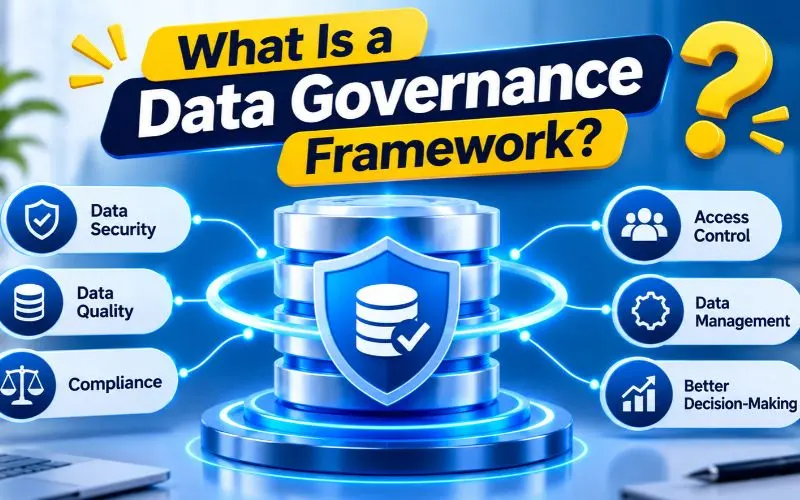
A data governance framework is a set of roles, policies, and processes for managing data. It shows who owns data, who can use it, and how to keep it safe. Think of it as the rulebook that turns raw data into a trusted business asset.
Strong frameworks sit on top of everyday data management. They link your data governance strategy to daily work. Teams know what to do, who decides, and where to raise issues.
If you are new to the topic, IBM’s overview of data governance is a helpful starting point. This guide goes further and shows how the pieces fit together.
Why a Data Governance Framework Matters
Most companies hold more data than ever. Few can say who owns it or whether it is correct. A framework fixes that gap.
- Bad data leads to bad decisions and wasted hours.
- Unclear ownership creates gaps in data accountability.
- Privacy laws like GDPR carry heavy fines for mistakes.
- Growing data volumes raise data security and privacy risks.
- Analytics and AI projects fail without trusted inputs.
A clear framework reduces these risks. It also helps every team trust the numbers they use.
Core Components of a Data Governance Framework
Every framework looks a little different. Strong ones share the same building blocks. Here are the components you need.
1. Data Governance Strategy and Goals
Your data governance strategy explains why governance exists. It links data work to business goals. Maybe you want faster reporting, lower risk, or better customer insight.
Write down two or three clear goals. Tie each one to a result you can measure. This keeps the program focused and easy to defend to leadership.
2. Data Governance Charter
A Data Governance Charter is a short document that gives your program authority. It states the purpose, scope, and decision rights. It also names the people who sponsor the work.
Without a charter, governance feels optional. With one, teams know the rules carry weight.
3. Roles and Responsibilities
People make governance work. Each role needs clear duties. Vague roles lead to missed tasks and finger-pointing.
Role | Main Responsibility |
Data Governance Council | Sets direction, approves policies, and settles major disputes |
Chief Data Officer (CDO) | Leads the data strategy and reports to executives |
Data Governance Committee | Makes day-to-day decisions and reviews policy changes |
Data Owner | Holds final accountability for a data domain |
Data Steward | Watches quality, definitions, and proper use of data |
Data Custodian | Manages storage, access controls, and technical safeguards |
Data ownership and data stewardship are often mixed up. Owners are accountable for the data. Stewards handle the daily work of keeping it clean and consistent.
4. Data Governance Policies and Procedures
A Data Governance Policy states the rules for handling data. Procedures explain how to follow those rules. Together, your data governance policies and procedures turn ideas into action.
Good policies cover access, retention, sharing, naming, and issue handling. Keep them short. Long policies sit unread in shared folders.
5. Data Quality Rules and Standards
Data Quality Rules define what good data looks like. A rule might say every customer record needs a valid email. Another might require dates in one format.
Governance sets the rules. Data quality management puts them to work through checks, cleaning, and monitoring. You need both to keep data reliable.
6. Data Lifecycle Management
Data has a life from creation to deletion. Data lifecycle management guides each stage. It covers capture, storage, use, archiving, and safe disposal.
Clear lifecycle rules cut storage costs. They also lower risk, because old data you no longer need cannot leak.
7. Data Security and Privacy Controls
Data security and privacy protect your most sensitive information. Controls include role-based access, encryption, masking, and audit logs. Custodians usually run these controls. Owners decide who should have access.
8. Data Compliance and Regulatory Alignment
Data compliance means following the laws that apply to your data. For many firms, that includes GDPR. Regulatory Compliance under GDPR demands lawful use, clear consent, and quick breach reporting.
Your framework should map each rule to a policy, an owner, and a control. That makes audits far less stressful.
9. Metrics, Tools, and Monitoring
You cannot improve what you do not track. Pick a few simple metrics. Examples include data quality scores, policy exceptions, and issue resolution time.
Tools help too. Data catalogs, lineage maps, and access platforms make rules easier to enforce at scale.
Key Benefits of a Data Governance Framework
- Better data quality: Shared rules mean fewer errors and duplicates.
- Faster decisions: Teams find and trust data without long debates.
- Lower risk: Clear controls reduce breaches and compliance failures.
- Stronger accountability: Every dataset has a named owner and steward.
- Lower costs: Less rework, less duplicate storage, and fewer audit surprises.
- Better analytics: Reliable inputs lead to results people believe. See how this supports data analytics in practice.
Examples of Data Governance Frameworks
You do not need to start from zero. Several respected models can guide your design. Here are the most common ones.
DAMA DMBOK
The DAMA International body publishes the DMBOK guide. It covers 11 knowledge areas, including data governance, data quality, and data security. Many teams use it as a shared vocabulary.
Data Governance Institute (DGI) Framework
The DGI framework focuses on rules, people, and processes. It helps you decide who makes decisions and how. It suits organizations that want a clear, simple structure.
Industry Examples in Practice
- Banking: A bank assigns owners to customer and transaction data. Stewards run quality checks, and the CDO reports risk to the board.
- Healthcare: A hospital limits patient record access by role. Custodians log every access for audits.
- Retail: A retailer sets one definition of “active customer.” Marketing and finance finally report the same numbers.
For more perspective, the DATAVERSITY guide to data governance frameworks compares several approaches.
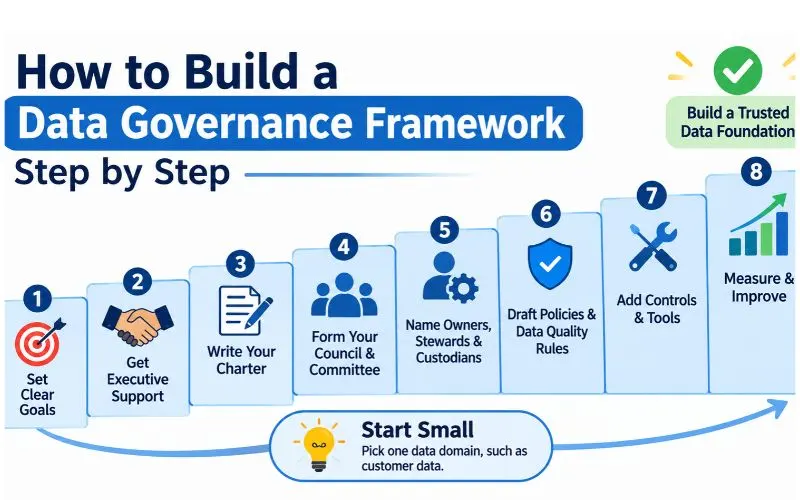
How to Build a Data Governance Framework Step by Step
- Set clear goals. Link governance to a real business problem.
- Get executive support. A sponsor, often the CDO, gives the program weight.
- Write your charter. Define scope, authority, and decision rights.
- Form your council and committee. Include people from business and IT.
- Name owners, stewards, and custodians. Give each role clear duties.
- Draft policies and data quality rules. Start with your most critical data.
- Add controls and tools. Cover access, privacy, lineage, and monitoring.
- Measure and improve. Review results every quarter and adjust.
Start small. Pick one data domain, such as customer data. Prove the value, then expand to other areas.
Common Challenges and How to Avoid Them
- Treating governance as an IT project. Involve business leaders from day one.
- Trying to fix everything at once. Focus on high-value data first.
- Writing policies nobody reads. Keep them short and practical.
- Skipping training. People follow rules they understand.
- Ignoring change. Review your framework as laws, tools, and goals shift.
How Wisdom Tech Cloud Services Can Help
Building a framework takes time and the right technical foundation. Wisdom Tech Cloud Services helps businesses organize, secure, and use their data with confidence. Explore our data and cloud services to see how we can support your governance goals.
You can also read more guides on our data and cloud blog.
Frequently Asked Questions
What is a data governance framework in simple terms?
It is a set of roles, rules, and processes that guide how a company manages data. It makes sure data stays accurate, secure, and compliant.
What are the main components of a data governance framework?
The main parts are strategy, a charter, defined roles, policies, data quality rules, lifecycle management, security controls, and compliance alignment. Metrics and tools support them.
What is the difference between data governance and data management?
Data governance sets the rules and decision rights. Data management carries out the work, such as storage, integration, and cleaning. Governance guides, and management executes.
Who is responsible for data governance?
Responsibility is shared. The Chief Data Officer leads the program. Data owners are accountable, stewards manage quality, and custodians handle technical controls.
What is the role of a data steward?
A data steward watches over data quality, definitions, and proper use. They fix issues, enforce standards, and help users understand the data.
How does a data governance framework support GDPR compliance?
It maps GDPR rules to policies, owners, and controls. It also tracks where personal data lives. This makes consent, access requests, and breach reporting easier to manage.
How long does it take to implement a data governance framework?
A focused pilot can take two to three months. A full rollout often takes a year or more. Starting with one data domain speeds up results.